“Red” Blaik: Gridiron Leadership
Talk about a leadership legacy — when you have Douglass MacArthur for a mentor and Vince Lombardi for a protégé, you’re bound to be an extraordinary person. And Coach Red Blaik, the finest football coach ever at the United States Military Academy at West Point, had a distinctive bond with both of these bigger-than-life Americans.
While at West Point, Blaik coached more years (17), won more games (121), and captured more National Championships (1944-1946) than any other coach in the 120-year history of US Army college football. “The Colonel,” as he was called by his players, also produced six unbeaten seasons and coached three Heisman Trophy Award winners (Doc Blanchard, Glenn Davis, and Pete Dawkins).
During Blaik’s glory years’ college football ruled supreme as America’s leading fan sport. Back then it was common for national newspapers to run several full pages of news and photos on big college football teams like Army.
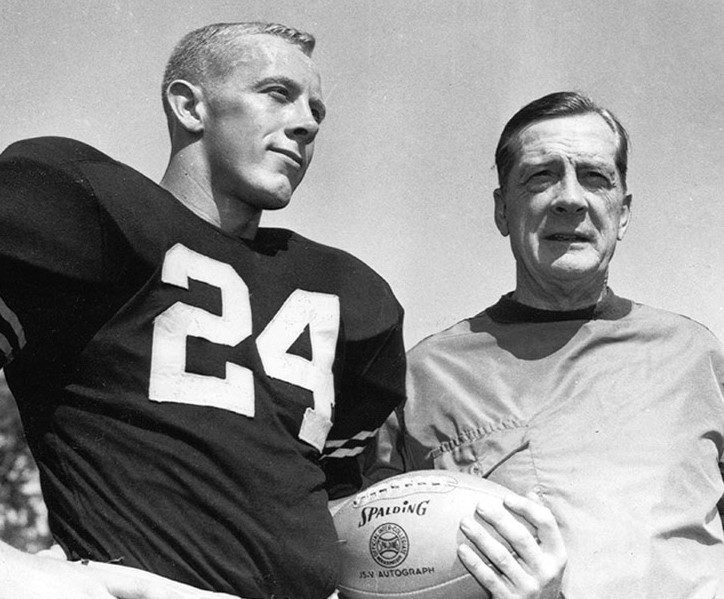
Pete Dawkins with Coach Red Blaik at West Point, 1958. For more read Peter Dawkins: A Call to Duty — HERE.
The key to his gridiron greatness was rooted in the fundamentals — practice, planning, and preparation. “Coach Blaik won most of his games before he stepped on the field,” explained Mark Beech, a former Sports Illustrated associate editor and author of When Saturday Mattered Most: The Last Golden Season of Army Football. “He only had the players for about two hours a day and he drilled them relentlessly,” Beech said. “He made the most of his time.”
Blaik was an early innovator, Beech explained. “He didn’t invent game film study, but he probably perfected it. He was one of the first guys to make extensive use of it. It was a great way to breakdown things and teach basics. He was famous for calling his assistants at odd hours and watching film all through the night.”
On the personal level, “he was widely regarded as aloof and stern by his players,” said Beech. “He wasn’t a flamboyant man. There was little or no talking to players. He wasn’t interested in being your friend. There were firm rules on his team and players rarely spoke at practice. Blaik mostly communicated through his assistant coaches.”
“I have a secret and dangerous mission. Send me an Army football player.” —General George Marshall
Beech, a 1991 West Point graduate and retired US Army caption, compared Blaik’s management style to that of a company CEO. “He loved to debate strategy, techniques, and tactics but once a decision was made that was it,” he said. “There were clearly defined roles and all his assistants and players followed the rules to the letter.”
Blaik had a huge influence on the career of Vince Lombari, who assistant coached at West Point from 1948-1953. This iconic football coach and namesake of the NFL championship game trophy, later became a pro football legend guiding the Green Bay Packers to a total of five NFL titles, including the first two Super Bowls in the mid-1960s.
“Lombardi would later say everything he learned about football — organizing, training, determination and preparation — he learned from Blaik,” said Beech. “Everyone knows about Lombardi’s relentless practice of the Packer sweep. Well, that goes back to the way Blaik drilled his teams at Army.”
Pulitzer Prize-winning author David Maraniss explained that while Blaik “was by no means a perfect leader (there was a major cheating scandal at Army during his tenure), he did give Lombardi some great lessons during his time at West Point.” Maraniss, the author of When Pride Still Mattered: A Life of Vince Lombardi, the signature tome on Lombardi’s life, said “the most important lesson had to do with mastering the fundamentals and paying attention to details. In their first meeting, when Blaik was deciding whether to hire Lombardi, he asked Lombardi to describe how he taught blocking on the offensive line. They spent an hour talking about the correct distance that each lineman should stand apart from the next in order to be most effective. Lombardi passed the test, and their mutual insistence on exactitude bonded their relationship.”
Blaik also reiterated a lesson that Lombardi had learned from the Jesuits who taught him at Fordham, the notion of freedom through discipline. “Only by mastering the fundamentals can you have the freedom to respond to any situation, the knowledge and confidence to deal with the unexpected and control events rather than having them control you,” Maraniss said.
Born in February 1897 in Detroit, Michigan, Blaik’s family later moved to Ohio where he earned an undergraduate degree at Miami University (later to be nicknamed the “Cradle of Coaches” for its production of great grid leaders). Eager to help with the WWI effort, Blaik won appointment to West Point, played football there, and graduated in 1920.
One of Blaik’s idols dating back to the time he was a young cadet was General Douglas MacArthur. “When MacArthur was appointed West Point superintendent in 1919 (the youngest in its history) a strong connection began,” said Beech.
During the first meeting with the general, Blaik and a few other cadets were nervous, but MacArthur, in full dress uniform, was able to put them at ease by offering cigarettes, said Beech. Thereafter, the relationship became very close. “MacArthur was known to walk the football sidelines (with his riding crop and flopping hat) and cheer on Blaik and his team,” said Beech. It apparently helped; Blaik was named an All-American and voted the best athlete in his class. “MacArthur saw football as a perfect metaphor for warfare — with its offense and defense and attacks and long bombs,” said Beech. “Football was the best game a young solider could play.”
Blaik first made his name as head coach at Dartmouth, where he had a respectable 45–16-1 record. In 1941, with back-to-back losing seasons for the first time in 30 years, West Point abandoned a long-standing policy requiring its head coach to be an active duty officer and hired Blaik.
Beginning in 1944, Army went on an amazing three-year run going 27-0-1 and wining three national championships. “Those Army teams may have been the finest collection of talent at one time on one football field ever,” Beech explained. “And while Blaik had them ready to play he also had some advantages.”
“Those teams benefited from the platoon system which then allowed for unlimited substitutions,” said Beech. “Blaik was also helped because he could cherry pick players from around the country, because if you went to West Point you could delay your draft. They had the great players who would be otherwise going off to war. So the war helped him. They were incredible, phenomenal teams that could not be touched. Leading the way was perhaps the most celebrated pair of runners in football history, Felix “Doc” Blanchard and Glenn Davis, who would earn football immortality as “Mister Inside” and “Mister Outside.”
In 1951, the school was involved in an honor code scandal where 90 cadets were expelled from West Point for cheating on exams. More than one-third of those caught were members of Blaik’s varsity football team including his son, Bob, the team’s starting quarterback. “It was a tremendously wounding to him and he was going to quit,” said Beech. “But he stayed on at the urging of General MacArthur.”
He would rebuild Army football through the 1950s “and redeem his team and his family name when they went undefeated in 1958,” said Beech. The cornerstone of that team was Pete Dawkins, who won the Heisman Trophy that year. “What Coach Blaik really wanted for all of us was to be the best we possibly could be,” said Dawkins. “His players understood that’s what motivated him.”
Dawkins, who went on to live an amazing life (US Army General, Rhodes Scholar, Princeton PhD, and Wall Street financier), believed that Blaik was more formal than aloof. “The man wore a three-piece suit and a fedora hat to every game I ever played for him,” Dawkins said. “He was an old-school gentleman.”
An understanding of the MacArthur veneration was clear the first time Dawkins met the coach in 1954. “Blaik had this massive painting of the general hanging in his office — there he was, larger then life-size, looking down at you,” Dawkins explained.
Blaik died at age 92 in 1989 in Colorado Springs (ironically, the home of the US Air Force Academy). He is buried at West Point.